


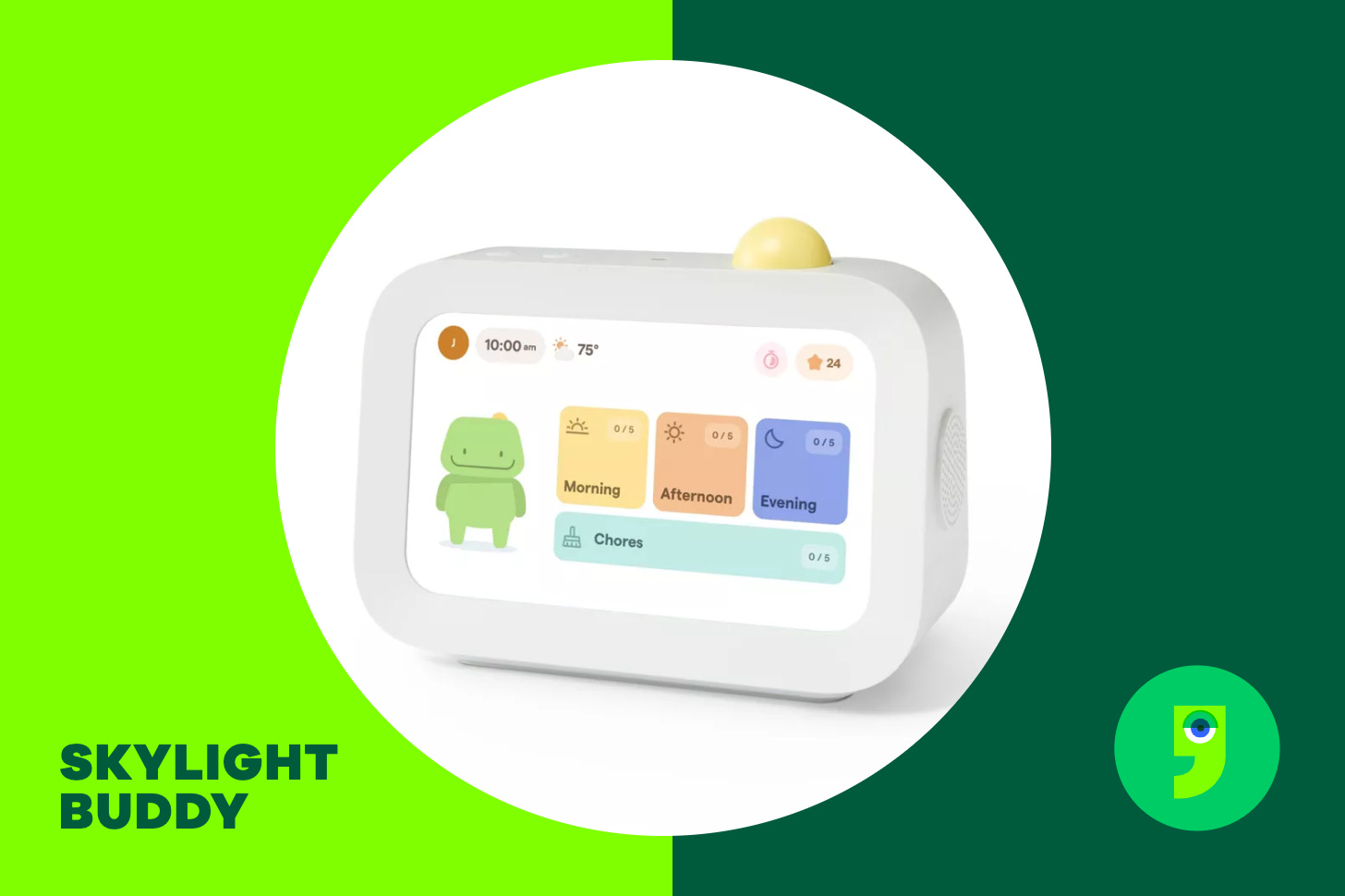
I’ve been going deep on kids’ products lately, partly because of my day job on Duolingo Math and partly because I’m a parent who can’t stop buying and testing things. So when the Skylight Buddy showed up in my LinkedIn feed, and eventually made its way to my daughter’s nightstand, I had to find out who designed it.
A few weeks back, the Freckle launch went viral for creating a $199 phone for kids ages 7 to 13 with no app store, no browser, and no social media. Instead, it uses AI to identify whatever a kid snaps a photo of and answer their questions about the world, and pairs that with a mini-map, a walkie-talkie, and parent-made “Quests” that send kids outside. It follows Tin Can, the landline-style phone for kids that blew up this year and has sold hundreds of thousands of units (here in Minnesota, it feels like every family has one).
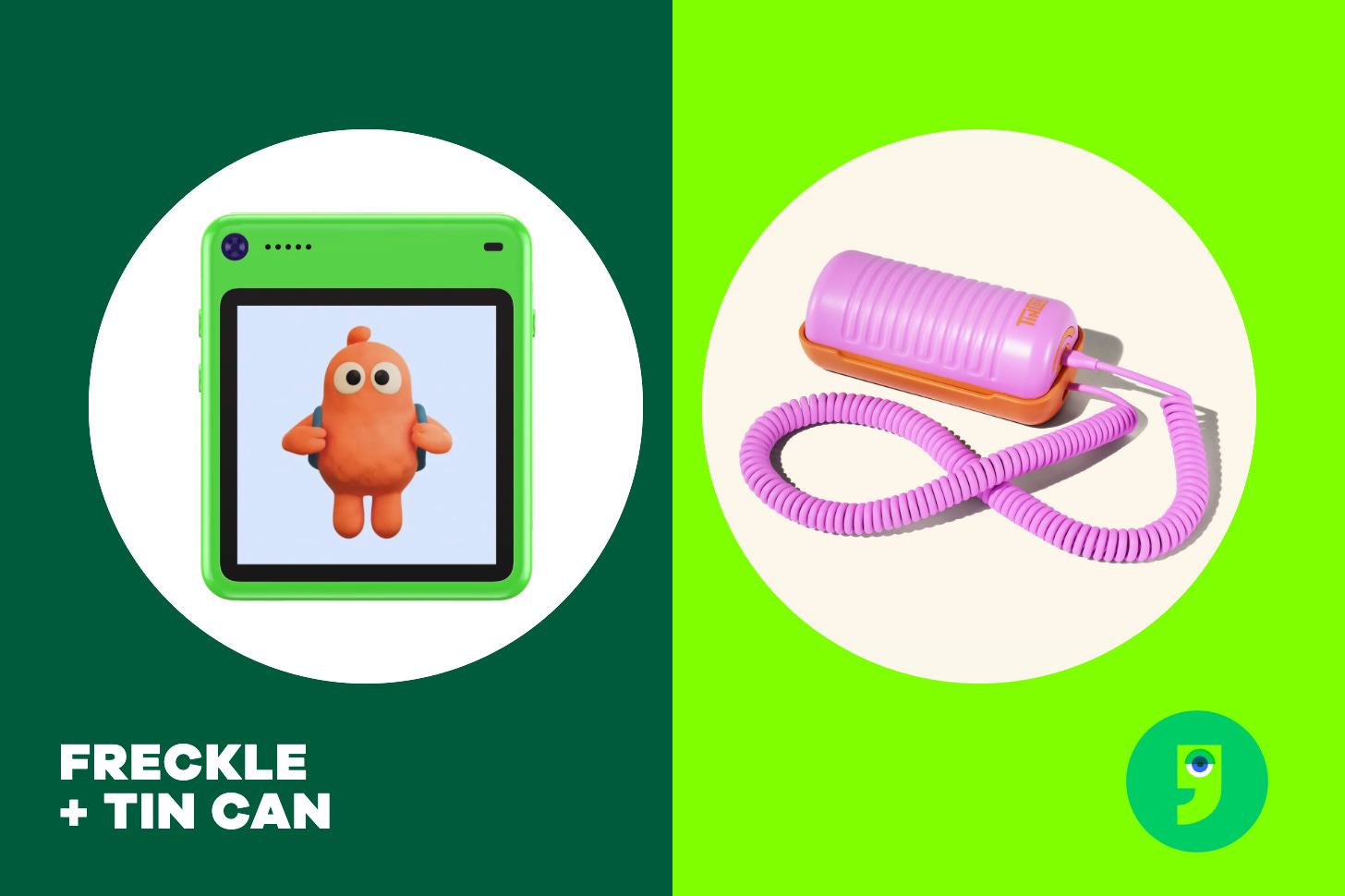
Neither of these is flashy. They’re utilitarian, almost humble pieces of hardware that do a few jobs for kids really well. And they exist because we can finally build them: advances in AI let a small team put real capability into a simple, purpose-built device without handing a kid a full smartphone. Or, because of the over-wired moment we’re all in, they go back to the basics and add utility to a simple physical product (like a landline!). As Nichole put it when we talked about the empty canvas in kids’ tech, “nobody’s really gotten it right,” but the technology is finally ripe.
That’s what made this conversation so fun. Nichole thinks about physical products the way I wish more software builders thought about theirs. I hope you enjoy it, and as always, send me your feedback on the format!
This week, Nichole Rouillac, founder and creative director of level, joins me to talk about designing hardware for kids and families, and why the best design is the kind nobody notices.
Nichole has spent her whole career in Silicon Valley putting new-to-the-world hardware into people’s hands for the first time. Her early claim to fame was building the first Fitbit, and she went on to launch some of the earliest Android devices. Ten years ago, she founded level, an independent, women-led industrial design studio in San Francisco. The studio is behind products like Nex Playground, which has sold over a million units, and Skylight Buddy, both recognized by TIME’s Best Inventions.
We talk about:
Whether hardware is back, and why she hopes it’s the meaningful kind
The design battle behind the Skylight Buddy’s big button
Designing for how kids actually use things, including all the ways they surprise you
Why she won’t let her team open CAD until the design is figured out (with cardboard!)
How she trains junior designers by putting them in front of CEOs
What AI still can’t do in industrial design
The products that made her feel like she was living in the future
My biggest takeaways from our convo
Hardware is back, but it should earn its place. Nichole is excited that hardware is having a moment, but she doesn’t want AI turning into more stuff that ends up in a landfill. The opportunity is in software that enables physical things that couldn’t exist before, not slop-gadgets nobody needs.
People want tactility and fewer screens. Records, flip phones, and no-screen devices are back for a reason. People are tired of touchscreens and want technology that gets them outside and closer to each other. There’s a big empty canvas here, especially for kids! (Nickey’s request: someone please build the new-age iPod for kids and I’ll write you a check!).
Kids love buttons, so fight for the button. Skylight is a software-first team, and their user testing suggested the Buddy didn’t need physical buttons. Nichole showed them a video of a kid smashing the giant button on a toy car and said, “I’m a mom, I have a toddler, I know they love buttons.” That button became the defining feature of the product. Sketched animations of stars falling when you press it sealed the deal.
The best design is invisible. AI can generate product concepts, but Nichole can usually tell they’re not manufacturable or not tasteful. It can’t yet figure out how a person will hold something, wear it, or understand it instantly. In her words, the best thing ever is “when people don’t know that our job exists because we just get it right.” The more AI takes over, the more we’ll run into products where we ask, “Why did they make it that way?”
Design for real kids. Kids are curious, physical, and endlessly inventive. They find workarounds you’d never expect, and their fine motor skills are still developing, so everything they touch needs big, broad movements, not the precision we expect from our phones. And things will hit the floor. Nichole hates protective cases because they’re ugly, so she designed Buddy’s case into the product: it looks good in a kid’s room and holds up when it inevitably takes a tumble.
The details that feel obvious take dozens of tries. It took around 30 prototypes to get Buddy’s angle right: visible from beds of different heights, hard to tip, and sturdy enough that it won’t slide backwards when a kid pushes the button. Nichole’s team solves most of this in cardboard and full-scale paper prints on the wall, she pushes her team to think with their hands before jumping into CAD.
Throw junior designers into the fire (with a net). At level, even interns sit in client meetings, and every designer presents their own work, even to a CEO. It pushes them to build the skill of explaining the why behind a design, and the passion comes through in a way a manager’s retelling can’t match. It reminded me of product review at Duolingo, where anyone can shadow and everyone’s product sense gets better by watching feedback happen.
I won’t share more. You’ll have to watch! I hope you enjoy it.
Where to find Nichole Rouillac
Where to find Nickey
In this episode, we cover:
(00:00) Welcome, Nichole!
(00:28) Founding level, building the first Fitbit, and early Android devices
(01:33) Is hardware back?
(03:23) What she’d tell industrial designers to build next
(04:50) The fridge with a broken screen, and right to repair
(05:44) Designing “forever products”
(06:40) Getting kids off phones: the Apple Watch compromise and tin can phones
(08:36) The missing kids’ music device
(09:51) Why we both love the Yoto
(10:53) Designing the Skylight Buddy
(13:33) Fighting for the big button
(16:13) Designing for how kids really use things: the integrated case
(16:58) Motor skills, and designing for both kids and adults
(18:27) Testing with a cohort of real families
(20:02) Her kids as ergonomic testers, models, and sketch partners
(21:08) Nex Playground: a motion-based console for active family play
(23:24) The sketched button animation that won over the client
(23:55) How she built her craft: color, material, and finish, and time in factories
(26:19) Why her team doesn’t touch CAD until the design is figured out
(28:05) 30 prototypes to get Buddy’s angle right
(29:36) Training junior designers by throwing them into the fire
(32:14) Duolingo’s product review ritual
(33:20) Daily design reviews before lunch (because daycare charges by the minute)
(35:00) Why junior designers present their own work to clients
(37:07) What AI can’t do in industrial design
(39:21) “People don’t know our job exists because we just get it right”
(40:34) Lightning round: the product every builder should try
(42:50) The products she wishes she’d created
(44:20) Riding in Zoox and Waymo
(46:22) Robotaxis for parents tired of being the chauffeur
(47:18) The best book for building your craft
(49:00) Airbnb Experiences and what makes a great day
Referenced:
level: https://www.leveldesignsf.com/
Skylight Buddy: https://www.skylightframe.com/
Nex Playground: https://www.nexplayground.com/
Fitbit: https://www.fitbit.com/
Board: https://board.fun/products/the-board?srsltid=AU7gw4WRrkNGg7AxzNksW5qyws1hCvscjTnlJMCGjwjxtbS4sguSKnh4
Tin Can: https://www.tincan.kids/
Freckle’s new kids’ phone (Engadget): https://www.engadget.com/2273319/freckles-smartphone-aims-to-get-kids-back-outside-on-their-own/
“The hottest phone for kids right now is a US$100 landline”: https://www.thestar.com.my/tech/tech-news/2026/04/27/the-hottest-phone-for-kids-right-now-is-a-us100-landline
Yoto: https://www.yotoplay.com/
Tonies: https://tonies.com/
iPod Nano and iPod Mini
Tesla: https://www.tesla.com/
Zoox: https://zoox.com/
Waymo: https://waymo.com/
Rebel Chef by Dominique Crenn
Airbnb Experiences: https://www.airbnb.com/experiences
Duolingo Math: https://www.duolingo.com/math


