


Wow, hello again! It’s been over a year since I last sent this newsletter. You’d think I’d have a good excuse for being gone so long, but like a lot of operators with a 9-to-5, “talking about what I’m working on” fell by the wayside.
That said, I was really excited to record this conversation with one of my favorite coworkers at Duolingo, who’s doing some of the most interesting work in the industry right now. I hope you enjoy it. And please send me any feedback on this new format (video! podcast! eek!).
This week, Joseph Staten, Associate Creative Director at Duolingo, joins me to talk about the craft of narrative design in games and digital products.
Joseph is a legend in gaming. He spent 20+ years making AAA console and PC games, including a long run on the Halo series, where he helped bring characters like the Grunts to life (”with his teams,” as he’d graciously put it). At Duolingo, he’s one of the chief architects behind Oscar, the fragile-genius chess opponent you may have met if you’re one of the millions of people who’ve played Chess on Duolingo. This year, he and I also worked together to bring Eddy to life in Duolingo Math.
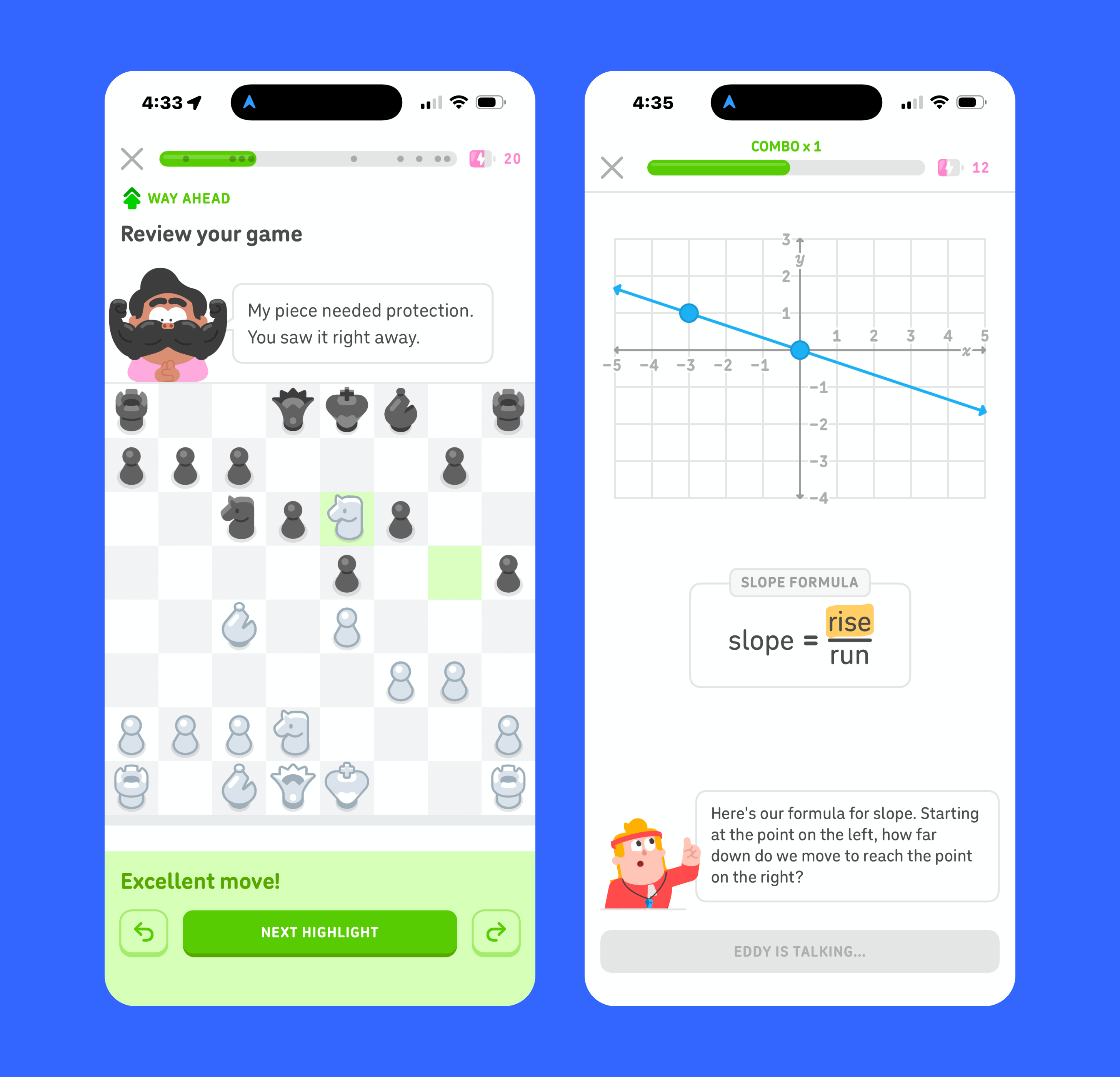
Joseph thinks deeply about what makes a character someone you want to root for, argue with, or beat. He also has a lot to say about how AI is changing the way creative work gets made. We talk about:
Why “taste” is really just hard-won scar tissue
How AI can help you fail quietly, out of the spotlight, and why that’s kinder to teams
Designing Oscar: finding a character’s extremes and landing on “the fragile genius”
Whether AI agents should have a personality
Why humor is one of the best tools for making hard things feel doable
What moving from games to learning taught him about iteration
My biggest takeaways from our convo
Taste is scar tissue. People with great craft usually got there by failing over and over: painful user research sessions, rough betas, “staring at the flaming ball of disaster your product is before it’s great.” Joseph’s test: “I’ll believe your taste when you show me the terrible experiences you had to go through to get there.”
AI lets you fail quietly, out of the spotlight. In the olden days (two years ago, lol), prototyping was so expensive that you had to make big decisions early. Now an idea is cheap to try, and if it doesn’t work you move on. Joseph’s point that this is humane stuck with me: it spares big teams the crushing experience of putting their best on the table and hearing “back to square one.”
Celebrate failure. Delaying the hard conversations only makes them harder. Share what didn’t work widely, so everyone builds taste, even people who weren’t in the trenches. (At Duolingo, we post “gone but not forgotten” tributes to shelved projects.)
Find your character’s extremes. Joseph asks of every new character: what would they die for? What would they kill for? For Oscar, that became: what does he really want, what’s stopping him, and how does he react when he fails? The answer was “the fragile genius.” He brags that he never loses, then collapses into a little ball when you beat him. You end up rooting for him even while he’s trying to beat you.
Humor lowers the stakes of hard things. Learning a language (or math, or chess) can be scary. Everyone, everywhere, has met a fragile genius, so everyone laughs at Oscar for the same reason. Humor crosses divides and makes it OK to make mistakes.
Should your AI agent have a personality? It depends on the job. Joseph strips personality out of his tools in builder mode (”Don’t shine me on. Be brutally honest. Explain why.”). I think that for anything fun or consumer-facing, people will want characters they co-create, which means narrative design is about to pop off. Watch this space.
Writing is rewriting. Nothing is good until the third draft. To build your craft, dissect whatever grips you (a book, a TV script, a play) and ask why it works.
I won’t share more. You’ll have to watch! I hope you enjoy it.
Where to find Joseph
Where to find Nickey
In this episode, we cover:
(00:00) Welcome, Joseph!
(00:39) From 20+ years in AAA games and Halo to Duolingo
(02:04) Bringing Eddie to life in Duolingo Math
(02:49) How game development has changed across eras, from 50-person teams to the HD era
(05:06) Advice for building craft when you’re just starting out (07:06) AI helps you “fail quietly, out of the spotlight”
(08:15) The emotional cost of big-team failure
(10:54) Taste is scar tissue
(13:16) Celebrating failure and sharing what you learn
(14:03) Duolingo’s “gone but not forgotten” posts for shelved projects
(14:33) How Halo teams got user signal before social media
(16:25) “The truth is always in the software”
(16:48) The Grunts, and why great characters are a team effort
(18:13) Designing Oscar for Duolingo Chess: a dynamic dialogue system
(20:36) “What would this character die for? What would they kill for?”
(21:34) Oscar’s archetype: the fragile genius
(23:16) Should your AI agent have a personality?
(27:11) The industry debate over human-like AI
(28:38) Going from games to learning
(30:35) Why Duolingo iterates faster than AAA games do
(33:10) Using humor to lower the stakes of hard things
(34:31) Lightning round: the game every builder should play
(36:16) Lightning round: The character he wishes he’d written
(37:06) Lightning round: The best writing advice he ever got
(38:09) Lightning round: The best book for building your craft
(40:57) Bonus tip: read the scripts of shows and movies you love
Referenced:
Duolingo Chess: https://blog.duolingo.com/chess-course
Duolingo Math: https://www.duolingo.com/math
The Duolingo Handbook (home of the Green Machine and our culture of experimentation): https://blog.duolingo.com/handbook/
Meta debuts Muse, its personal AI agent: https://www.axios.com/2026/09/08/meta-debuts-muse-personal-ai-agent
A Code of Conduct for Humanist AI, by Mustafa Suleyman (Microsoft AI): https://x.com/mustafasuleyman/article/2099488602418028917
Roblox: https://www.roblox.com/
Minecraft: https://www.minecraft.net/
The Three-Body Problem by Cixin Liu
The Hitchhiker’s Guide to the Galaxy by Douglas Adams
Jane Austen and William Shakespeare - no links needed, lol


